Showing posts with label depression. Show all posts

Tuesday, September 20, 2022

St. Johns’ Wort (Hypericum) and depression

Hypericum is a genus of about 450 species of trees, shrubs and herbs that occurs on all temperate parts of the world.

Hypericum or St. Johns’ Wort is the most widely used herbal antidepressant in the world. It is an effective treatment of mild to moderate depressed mood.

In Western Europe and the United States, St. John’s wort is the most widely used natural product to treat depressed mood.

Extracts from St. Johns’ Wort appear to exert an antidepressant action via weak inhibition of the enzymes monoamine oxidase, as well as a number of other effects on the central nervous system.

Use of St. Johns’ Wort dates back to the Middle Ages, when it was used to treat insanity resulting from ‘attack of the devil’.

It was named St. John’s in reference to St, John’s Day on the medieval church calendar because it blooms near that day.

It was found that its action was due to the substance named hypericin. St. Johns’ Wort is tolerated well by patients and has a very low incidence of adverse effects when taken properly.

St. Johns’ Wort extract was more effective than placebo in treating mild to moderate depression and patients taking the extract had no more negative side effects, than those people taking placebo.
St. Johns’ Wort (Hypericum) and depression 
Thursday, July 27, 2017

Medicinal herbs of St. John's Wort (Hypericum)

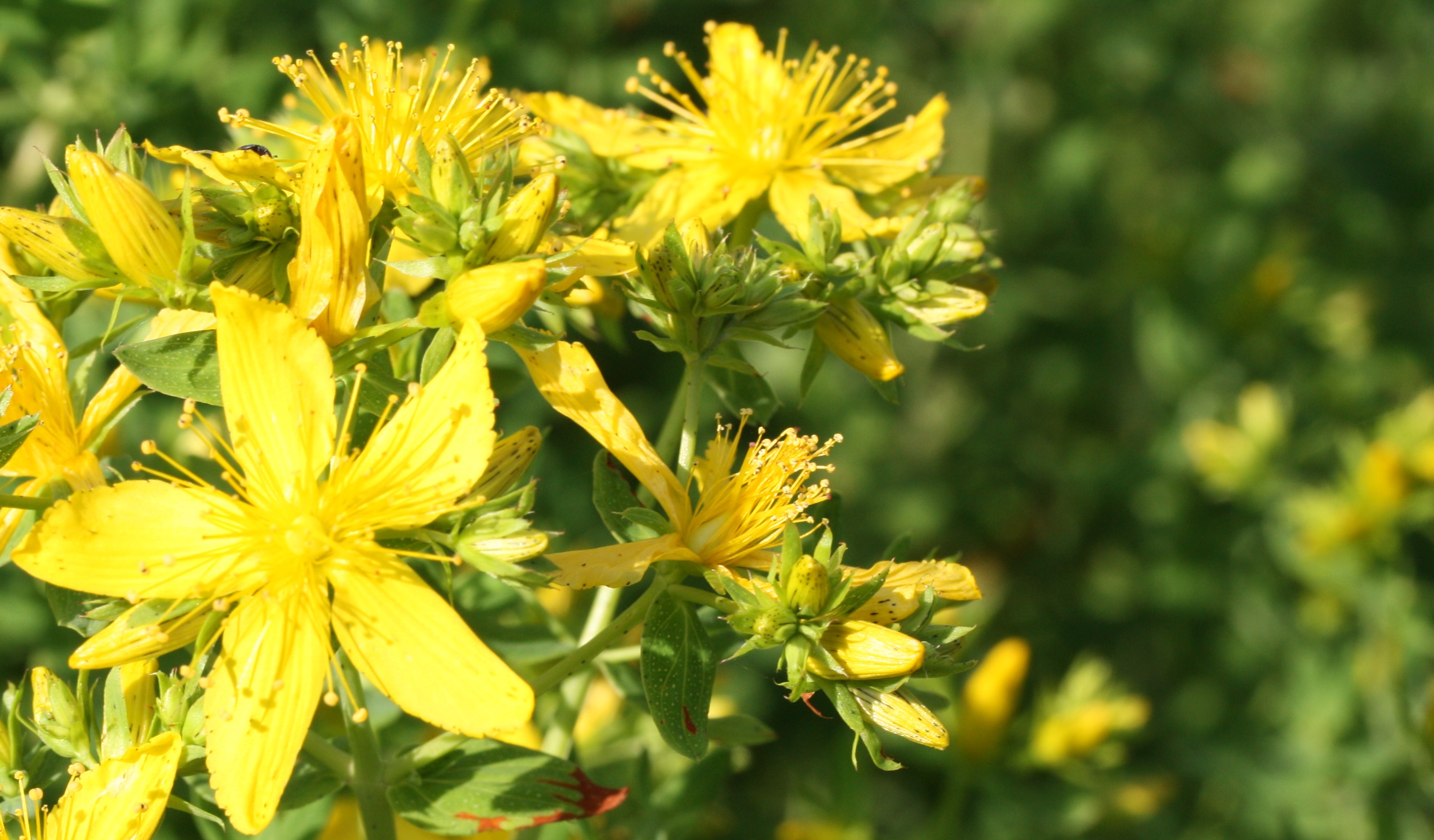
Hypericum (St. John's Wort) is a genus of about 450 species of trees, shrubs and herbs that occurs in all temperate part of the world but has only in species in southern South America and two species in Australia and New Zealand.

It is a perennial herbaceous plant with mature stems and branches that are smooth without hairs.

St. John’s Wort was first mentioned in Roman times by Pliny the Elder in the 1st century AD. Around the same times, Diascorides, a Roman army doctor born in Greece recommended the imbibition of St. John’s Wort with special liquids ‘to expel many choleric excrements’.

Hypericum belongs to the family Clusiaceae and shares with all or most of the other genera of that family opposite simple entire exstipulate leaves, the presence of glandular secretions, free petals, fascicles of stamens and seeds lacking endosperm.

Hypericum perforatum (devil’s scourage, goat weed, rosin rose, St. John’s Wort, Tipton weed, witch’s herb) contains the naphthodianthrones hypericin, and pseudohypericin, flavonoids, such as hyperoside, isoquercitin and rutin, and phloroglucinols, such as adhyperforin and hyperforin. It is effective in mild to moderate depression.
Medicinal herbs of St. John's Wort (Hypericum)

Tuesday, March 18, 2014

The use of hypericum (St. Johns Wort)

Hypericum perforatum, more commonly known as Hypericum or St. John’s Wort, is used widely because of the perception that it is safer, ‘natural’ antidepressant.

Hypericum extract has been used for the treatment of mild to moderate mental depression. From the existing literature, St. John’s Wort appears to be safe and effective alternative in the treatment of depression.

Two main constituent of Hypericum are thought to play a major role in the plant’s effect on depression. In addition to the originally identified active principle hypericin, other constituents such as hyperforin, adhyperforin and other related compounds are thought to play an active role in the modulation of depression.

Hypericum also has been used to treat nerve pain, mental and sleep disorders. Nowadays, it is used to lose weight because of its ability to control human appetite.

St. John Wort was originally believed in the Middle Ages to have magical powers that would protect one from evil.

The plant was originally named after John the Baptist because the flowers were said to bloom on the anniversary of his execution. It is commonly collected on June 25, St. John’s Day; it soaked in olive oil, eventually producing red oil symbolizing the ‘Blood of St. John’.
The use of hypericum (St. Johns Wort)

Popular Posts

Other Interesting Articles