Showing posts with label bay laurel. Show all posts

Friday, April 11, 2025

The Potential of Bay Leaves in Managing Type 2 Diabetes

Bay leaves, obtained from the Laurus nobilis tree, have gained attention for their potential role in managing type 2 diabetes. Traditionally used as a culinary herb, these leaves contain a range of bioactive compounds—including polyphenols, flavonoids, and essential oils—that may positively influence insulin activity and glucose regulation.

Recent clinical studies support the use of bay leaves in improving key markers of metabolic health. A 2022 randomized trial published in the Journal of Clinical Biochemistry and Nutrition reported that participants with type 2 diabetes who consumed 2 grams of bay leaf powder daily for 30 days showed significant reductions in fasting blood glucose, HbA1c, and insulin resistance markers. These effects are believed to stem from the leaves' antioxidant properties, which enhance insulin receptor function and reduce oxidative stress—a known contributor to insulin resistance.

In addition to glycemic control, bay leaves have demonstrated lipid-lowering effects. Research indicates that regular intake can lead to decreases in total cholesterol, low-density lipoprotein (LDL), and triglycerides, while elevating high-density lipoprotein (HDL) levels. This lipid profile improvement is crucial, as cardiovascular disease remains a leading cause of mortality among individuals with diabetes. A 2023 meta-analysis highlighted that daily bay leaf supplementation for 4 to 12 weeks significantly improved lipid panels without serious adverse effects.

The commonly recommended therapeutic dosage ranges from 1 to 3 grams per day, administered as a powder, capsule, or infusion. However, excessive consumption should be avoided due to potential toxicity from certain essential oils in the leaves. It is also important to use culinary bay leaves rather than ornamental varieties, which may be harmful.

In conclusion, bay leaves offer a cost-effective, natural approach to supporting blood sugar and lipid management in people with type 2 diabetes. While not a substitute for medical treatment, their incorporation—under professional guidance—can complement existing dietary and pharmacological strategies to improve metabolic health.
The Potential of Bay Leaves in Managing Type 2 Diabetes

Friday, April 23, 2021

Essential oil in Laurus nobilis

Laurus nobilis L. (Lauraceae) or bay leaf is an evergreen shrub indigenous to the south parts of Europe and the Mediterranean area, cultivated mainly in Europe and the USA as an ornamental and medicinal plant.

The essential oil obtained from its leaves has been used for relieving hemorrhoid and rheumatic pains.

The leaves have been used, in Iranian folk medicine, to treat epilepsy, neuralgia, and parkinsonism. Leaves and fruits have been reported to possess aromatic, stimulant, and narcotic properties.

Laurus nobilis essential oil has many health benefits, including supporting a healthy immune system, providing cleansing properties, and delivering powerful antioxidants.

Research shows that this essential oil also has an antimicrobial activity and antifungal activity.

The main components of the essential oil were cineole (44.1%), eugenol (15.2%), sabinene (6.2%), 4-terpineol (3.6%), αpinene (2.7%), methyl eugenol (2.5%), α terpineol (2.2%), and -pinene (2.1%).
Essential oil in Laurus nobilis

Friday, November 22, 2019

Bay laurel (Laurus nobilis)

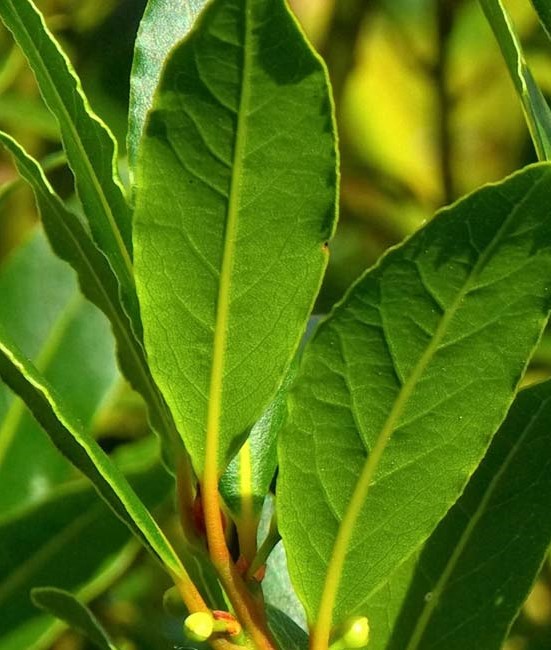
Bay laurel (Laurus nobilis) is an aromatic evergreen tree with green, glossy leaves, native to the Mediterranean region. It is also known as sweet bay, bay laurel, Grecian laurel, true bay and bay.

A similar tree is found in China but the variety is different and leaves contain an essential oil having a mark phenolic odor not unlike that of Pimento racemosa.

The leaves yield above 2% essential oil when steam distilled. Known as laurel by the Greeks who wore it as a garland round their heads.

Laurel leaves are directly used to flavor many dishes, particularly among Mediterranean cuisine. Moreover, from these leaves an essential oil is distilled, which is extensively used in the food industry for seasoning of meat products, soups and fish. These are evergreen ornamental plants with medicinal properties. These plants have been admired for its beauty and aromatic leaves since Greek and Roman times.

It has also been used to treat various types of cancer. Leaves and fruits of L. nobilis are used in folk medicine since antiquity. Traditionally, the leaf of L. nobilis has been recognized to possess many interesting properties to treat rheumatism, earaches, indigestion, sprains, and to promote perspiration.

Various pharmacological activities such as wound healing activity, neuro-protective activity, antioxidant activity, anti-ulcerogenic activity, anticonvulsant activity, analgesic and anti-inflammatory, anti-mutagenic activity, immuno-stimulant activity, antiviral activity, anti-cholinergic activity, insect repellent activity, antibacterial activity, antifungal activity and acaricidal activity have been reported.
Bay laurel (Laurus nobilis)

Popular Posts

Other Interesting Articles